
How Tight Hamstrings Impact Your Golf Swing Posture
Why Tight Hamstrings Hurt Your Golf Swing Posture
At FitGolf Performance Centers throughout the nation we periodically conduct research studies to study how the body influences the golf swing. One of studies examined the Toe Touch movement and how the inability to complete an adequate toe touch affects the golf swing. Understanding how the body limits your swing is the first step—once flexibility improves, golfers can focus on building core strength and rotational power to unlock their full potential. Pairing that flexibility work with a dedicated hip mobility routine to complement hamstring work gives you a well-rounded foundation for swing improvement.
The Toe Touch Test: How to Assess Your Hamstring Flexibility for Golf
To do the Toe Touch Test, stand with your feet together and knees straight. Now, try to touch your toes without your knees bending. Based off my experience I’ll venture to say that many of you cannot get to the toes without bending your knees. This is a problem for your golf game. Part of the reason it matters so much comes down to how hamstring tightness disrupts pelvic tilt—a chain reaction that undermines your posture before you even start your backswing. That chain reaction is also central to how hamstring tightness creates reverse spine angle—one of the most common swing faults we see in golfers with limited flexibility.
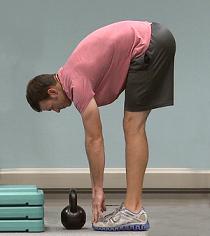
Research Results: How Toe Touch Ability Affects Golf Swing Consistency
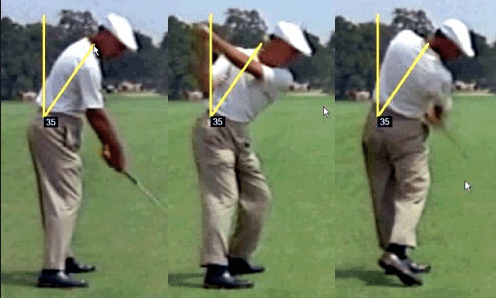
In our research study “Toe Touch and Spine Posture Stability”, we examined the implications of not being able to touch your toes. Based on observations, we predicted that not being able to touch your toes will create challenges with maintaining posture through the golf swing. This posture breakdown is closely tied to how hip mobility connects to lower back pain in golf—a relationship that compounds the postural stress caused by hamstring tightness.
In our study we tested 100 golfers to prove our hypothesis. We asked each participant to perform the toe touch test. Following the test, we assessed their body movement in the swing with the use of 3D Sensor Technology. If you’re wondering why so many golfers struggle with this test, it helps to understand the four root causes of hamstring tightness. We were able to determine that there was statistical significance to suggest that golfers who could touch their toes maintain posture better than golfers who can’t touch their toes. The practical takeaway is clear: fix your posture for more consistent ball striking by addressing the hamstring flexibility that underlies it.
We were able to determine that there was statistical significance to suggest that golfers who could touch their toes maintain posture better than golfers who can’t touch their toes. The implication: you can be a more consistent golfer if you can touch your toes! Part of translating that flexibility into a repeatable swing involves understanding back knee stability and hip coiling mechanics a key skill that builds directly on the hamstring freedom you’ve worked to develop. From there, the next step in your development is understanding hip rotation speed and downswing mechanics to translate that improved posture into real club speed. Pairing flexibility work with glute exercises to relieve hamstring tightness and gives you the best chance of carrying those gains into your swing.
The Toe Touch Fix: Hamstring Flexibility and Core Strength Exercises
A lack of hamstring flexibility is common, but it might not be the only reason you can’t touch your toes. Often, poor core strength leads to tight and overactive hamstrings. To improve your mobility, focus on both hamstring flexibility AND core strength—building a comprehensive foundation through golf flexibility fundamentals. If your lower back has been feeling the strain, you’ll also want to explore core exercises to relieve your lower back pain as part of your recovery and strengthening routine. One effective way to prepare your muscles is by rolling out tight hamstrings before you stretch—a technique backed by research that can make your flexibility work more effective. Try out the following exercises:
Before diving in, it’s worth understanding how hamstring tightness affects your address posture—so you can see exactly what these movements are working to correct. If you try these exercises and you find them to be too challenging or uncomfortable, do not continue, until you have consulted with your physician. All exercises for golf should be customized to your needs after a proper evaluation. For a broader starting point, explore these that complement the flexibility and core work outlined above. For a structured next step, explore these hip mobility exercises to complement hamstring work and build a complete lower-body foundation for your swing.
Get a Personalized Golf Fitness Assessment from a FitGolf Trainer
Want to take your golf to the next level? Our FitGolf® Trainers are experts at working one-on-one with you to tailor a training program to meet the specific needs of your body and help you achieve the results you are hoping to see in your golf. Once you have a program in place, use drills to transfer your new flexibility to your swing so your body improvements show up where it counts—on the course. Not sure where to start? Evaluate your physical ability to play golf to understand your current baseline before beginning a personalized program.
More Golf Fitness Exercises and Training Resources
Looking for more exercise resources, blog posts or monthly golf-specific exercise content sent straight to your inbox? You may also want to dive into core strength training for golfers as your next step once flexibility improves. One practical tool worth adding to your routine is foam rolling to improve hamstring flexibility—a simple, evidence-based method that can accelerate your progress between sessions.
