
What Is C-Posture and Why It Hurts Your Golf Swing
In a previous post titled “Stand Right So You Don’t Hit Right” we discussed how setting up in C-Posture at address can be detrimental to both your swing and back health. To review, C-Posture is when one rounds their shoulders and mid-upper back (thoracic spine) to address the ball as opposed to bending forward from their hips. This limits the amount of space the spinal joints have to rotate. As a result, a golfer that sets up in C-Posture tends to lose their posture within their swing with much more regularity than one that sets up in a neutral position. These postural breakdowns frequently lead to swing faults caused by poor posture and shoulder function that can increase injury risk over time. If you’re already experiencing discomfort, it’s worth taking time to strengthen your core and hips to protect your spine before these patterns lead to more serious issues.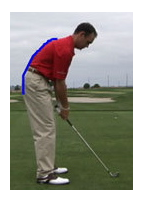
Upper Crossed Syndrome: The Root Cause of C-Posture in Golfers
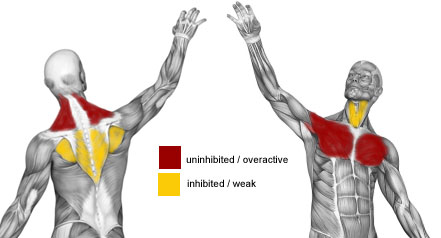
More often than not, correcting C-Posture is a tougher fix than simply pulling the shoulders back and straightening out the spine. One common cause of C-Posture stems from a condition called upper crossed syndrome. Simply defined, crossed syndrome occurs when one or more muscle groups are overly tight while their opposing muscle groups are weak or inhibited. In upper crossed syndrome, the pectoralis muscle group (chest muscles) is overly tight while the scapular muscle group (shoulder blade/mid-back muscles) is weak or inhibited. We commonly find that those with upper crossed syndrome are the same people that sit in a desk slouched over (in C-Posture!) for the majority of the day. This is a habit that is formed over numerous years of schooling and sedentary working and proves very difficult to break. It’s also worth noting that hamstring tightness and its impact on golf posture can compound these upper-body imbalances, as restricted hamstrings force the pelvis into a posterior tilt that further promotes rounding through the thoracic spine. Understanding correct golf posture at address is an important first step in recognizing why these muscular imbalances have such a direct impact on your setup and swing.
How to Fix C-Posture: Exercises to Improve Golf Posture at Address
In order to improve posture at address by correcting upper crossed syndrome, training must be aimed with the goal of regaining flexibility in the chest, and strengthening the scapular stabilizer muscles in the mid-back. It’s also worth understanding how pelvis alignment shapes your golf posture, as the lower body foundation directly influences how effectively you can maintain a neutral spine through these corrective exercises.
Swiss Ball Chest Stretch: Releasing Tight Pectoral Muscles
One great stretch to gain flexibility in the chest is the swiss ball chest stretch. To perform this stretch, grab a large swiss ball and position yourself by sitting on the ball. From here, walk yourself away from the ball until your mid-back and head are the only two things supported. Press your hips up and keep them in line with your shoulders. Now bring your shoulders and elbows to 90 degrees and press the back of your elbows and hands towards the floor. In this position you should feel a good stretch across your chest muscles and the front of your shoulders. Hold for about 60 seconds for 1-2 repetitions. For a broader set of corrective movements, the post on spine and shoulder mobility for better golf posture pairs well with this stretch as part of a complete preparation routine.
Reach, Roll, and Lift: Strengthening Scapular Stabilizer Muscles
In conjunction to keeping the front muscles in your chest loose, you must also strengthen the scapular stabilizer muscles of the mid-back. One simple exercise to do this is called the reach, roll, and lift. To begin, position yourself by kneeling down on the ground and sitting back onto your heels. Place both arms up on a swiss ball then take your right arm and reach out as far as possible over the ball and keep your trunk stable. Roll your palm over so it’s facing the ceiling and lift your arm up from the ball. Make sure your palm does not roll back over towards the floor and lift your arm only. Your shoulder and trunk should not elevate and extend. Do at least 2 sets of 10 repetitions for each arm. Building scapular strength for a connected swing is essential—once these stabilizers are firing properly, you’ll notice a significant improvement in both power and control through the ball.
Let me know if you have and questions or need any help with this stuff.
Jason
