
Improve your posture for consistent ball striking. However, in many instances, flawed movement throughout the swing stems from incorrect posture at address. Poor posture at address may also lead to low back pain and stiffness that many amateur golfers experience throughout a round of golf. The most common mistake is made by bending from the wrong area of the body. Understanding pelvic tilt’s role in golf posture at address is essential, as the pelvis is the foundation from which proper spine angle is established. Equally important is learning to improve hip stability for consistent ball striking, since the hips work in tandem with the pelvis to anchor the entire address position. Many amateurs tend to forward bend from the mid-back (thoracic spine), which is called setting up in C-Posture (due to the rounding of the spine into a C-shape).
How Poor Posture at Address Hurts Your Ball Striking
C-Posture limits the amount of space your spinal joints have to rotate in the back swing. This will prevent you from having a smooth and complete turn into the back swing which will ultimately cause a loss of posture in the form of a sway or reverse pivot. In other words, setting up with bad posture makes it extremely difficult to achieve consistent ball striking due to excessive body movement throughout the swing. Because poor posture at address causes bad patterning throughout the rest of the swing, the low back is placed under abnormal stress which may lead to pain and stiffness. To simply summarize, setting up in poor posture can ruin the swing before you even pull the club head back. It’s also worth understanding how hamstring flexibility affects your posture, as tight hamstrings are a common physical limitation that forces golfers into exactly this kind of rounded, C-Posture setup—and the science behind tight hamstrings and swing posture reveals exactly why this physical limitation is so difficult to overcome without targeted training.
Why Correcting Golf Posture Is Harder Than It Looks
It is easy to see and feel if you are set up in bad posture, but challenging to correct it. First, golfers must have a combination of sufficient flexibility, strength, and coordination to put their bodies into an ideal address posture and to be able to do it on a CONSISTENT basis. Second, they most have a strong understanding on how to initiate the movements necessary to consistently and safely put them into the correct position. If building that physical foundation is a challenge, exploring fitness fixes for better golf posture can help you develop the strength and flexibility required to hold proper address consistently. Pairing posture work with targeted exercises to eliminate swing flaws ensures that the physical improvements you build at address translate into a more consistent swing pattern overall. Here is a great drill to learn the movement necessary to get into perfect address posture:
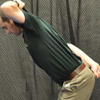
Club Behind the Spine Drill: Fix Your Golf Posture at Address
Stand tall and place a golf club behind your back with the club face pressed against your tailbone and the grip pressed against the back of your head. Next, flatten your back so your low back is firmly pressed against the club (Picture 1). Now, bend forward in such a way that the club shaft stays pressed against your head, tailbone, and low back THROUGHOUT THE WHOLE MOTION (Picture 2). Bend forward enough for the shoulders to get in line with your toes. This is the ideal positioning for posture at address. Once you’ve established this foundation, a consistent takeaway starts with better posture—so getting this position right sets you up for a more repeatable swing from the very first move. Pairing this with keeping your back knee bent for balance and power further reinforces the stable lower-body foundation your posture depends on.
If you use this club behind the spine drill to practice arriving at an ideal address posture, it will surely help improve all aspects of the swing and the consistency of your game. For a broader program, check out these exercises to improve posture and golf swing mechanics that complement this drill. If you’re preparing for the season, working through spine mobility exercises for better shoulder turn will help you build on the posture foundation this drill establishes.
Important Safety Note: Consult Your Physician Before Starting These Golf Exercises
If you try these exercises and you find them to be too challenging or uncomfortable, do not continue, until you have consulted with your physician. All exercises for golf should be customized to your needs after a proper evaluation.
If lower back discomfort is already a factor, incorporating stretches to relieve lower back stiffness can help you build the mobility needed to perform these posture drills safely and consistently. If you’re also dealing with compensations that developed from poor posture habits, it’s worth taking the time to fix your reverse spine angle at address, as this common fault often develops alongside the same physical limitations that cause C-Posture.
Improve Your Golf Posture Faster With a Personal FitGolf® Trainer
Want to take your golf to the next level? Our FitGolf® Trainers are experts at working one-on-one with you to tailor a training program to meet the specific needs of your body and help you achieve the results you are hoping to see in your golf. If poor posture has already taken a toll on your body, a trainer can also help you relieve the lower back pain poor posture creates so you can train and play with greater comfort and power. Rounding out your program with balance and stability exercises for your swing gives your improved posture a solid athletic foundation to build from.
Explore More Golf Fitness Exercises and Posture Training Resources
As you build a stronger address position, it’s also worth exploring how posture affects your kinematic sequence—because the chain of motion that drives consistent ball striking starts with the foundation you set at address. Strengthening that foundation through core stability exercises to support better posture is a natural next step once you’ve dialed in your address position.
