
Why Balance Matters for Your Golf Swing
I’ll be blunt. If you have poor balance, it’s very unlikely that you will produce a repeatable and consistent golf swing. In every good golf swing there’s good balance. Poor balance leads to bad body control and weight shift in the golf swing. Generally, consistent golfers do a great job shifting their weight to their trail leg in the backswing, and to their lead leg prior to impact. This weight shift pattern helps promote body stability in the swing. Bad balance will inhibit the golfer from successfully controlling their body and shifting the weight throughout the swing, leading to more swing flaws such as Loss of Posture, Early Extension, and Sway/Slide. One often-overlooked contributor is muscular tightness—understanding how tight hamstrings undermine your golf balance can reveal why some golfers struggle to stabilize even after dedicated balance training. To understand the full picture of how poor balance leads to bad golf swings, it helps to see exactly which swing characteristics are most affected and why.

How to Test Your Balance
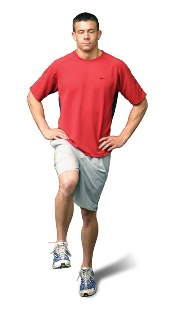
At FitGolf Performance Centers, we use the Single Leg Balance Test as one way to determine if a golfer is at risk of poor weight shift and swing flaws. As a golfer, you should test your balance using this Single Leg Balance test below: Once you know where you stand, you can put this same movement to work – try this single-leg exercise to improve balance and swing control as a direct next step in your training.
Single Leg Balance Test (Beginner)
1. First make sure you have adequate floor space with no objects you can trip over nearby. This test must be performed without shoes or sneakers.
2. Stand tall with your feet together, arms straight by your side, with your palms facing forward.
3. Slowly lift your right foot off of the floor and position the right leg so that both your hip and knee are at 90 degrees. Your knee should be directly i front of your hip, and your heel should be directly underneath your knee.
4. When you feel balanced and stable, close your eyes and begin to count. Hold the position as long as you can. Take note of your time and repeat on the other side.
Understanding Your Balance Test Results
If you were able to hold the single leg position with your eyes closed for 16 seconds, you passed. If you couldn’t make it to 16 seconds, you failed, implying that your balance, or lack thereof, could negatively impact your swing and make you a less consistent ball striker. If you’re over 50 and found this test difficult, it may not be a surprise – understanding how balance declines after 50 and affects your game can help put your results in context and guide your next steps. Once you have a clear picture of your balance baseline, exploring rotation control exercises after balance testing is a logical progression to build the stability and power your swing demands.
What to Do If You Failed the Golf Balance Test
Based off of my experience, most golfers fail the test the first time for reasons spanning wide, including poor leg, hip, and core strength, and/or poor proprioception. Proprioception is defined as, “A sense or perception, usually at a subconscious level, of the movements and position of the body and especially its limbs, independent of vision”. Unfortunately, as we age, proprioception deteriorates. This means that in order to maintain a consisten golf swing, the golfer must physically train to maintain and improve their proprioception. And if poor balance has already contributed to lateral movement faults in your swing, it’s worth taking the next step to fix the sway and slide in your swing before those patterns become ingrained.
3 Balance Exercises to Improve Your Golf Swing
Exercise 1: Single Leg Balance (Beginner)
This exercise is very simple, yet effective for beginners. Start by getting into a tall stable posture and stand on one leg. Once stable, try to balance yourself first with eyes open, and then eyes closed. Before closing your eyes, you should be able to hold the single leg stance with your eyes open for 20-30 seconds. Perform 3-4 sets on each leg and hold the stance for as long as you can. Once you’re proficient in the Single Leg Balance exercise, progress to Stork Turns. Keep in mind that balance training is just one piece of the puzzle—why mobility requires more than stretching is equally important to understand as you build a complete golf fitness foundation. As you progress, developing single-leg stability and back knee control becomes the natural next step toward a more controlled and repeatable swing.
Exercise 2: Stork Turns (Supported and Unsupported)
Using a golf club for support, pick up your right foot so you’re fully weight bearing on your left leg. Now, turn your lower body to the left to create a “pivot” in the left hip joint. Make sure you keep your chest facing forward as your hips rotate. Perform 3-4 sets x 10-15 reps each side. When you can perform 10-15 reps without losing your balance, place the golf club to the side and perform the Stork Turn Unsupported. (Tip: When you rotate your hips, focus on keeping your weight on the inside of the foot you are turning towards.) This hip pivot movement is a key reason why hip rotation needs stability, not just stretching—your hips can only rotate effectively when your standing leg provides a solid, controlled base. Once you can perform Stork Turns Unsupported without losing your balance, progress to Lateral Bounding
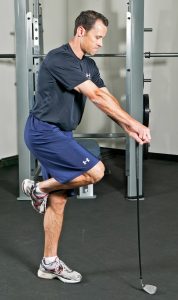
The subject would now turn his lower body to the left.
Exercise 3: Advanced Lateral Bounding
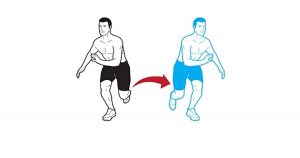
Get into a golf like posture and stand on your right leg only. Now jump to the side so you land on your left leg. Make sure you maintain your balance and the posture before jumping back to your right leg. The wider the jump is, the harder it will be to maintain your balance. Start with very narrow jumps and get wider as you improve. The width and speed of the jump is more important that the height of the jump. This exercise will not only help learn to accelerate and shift your weight, but also how to control the body and decelerate (just as important!) in the golf swing.
Key Takeaways: Improving Your Golf Balance Over Time
Balance exercises can be very frustrating, but be persistent! The more time you put into working on your balance, the more consistent of a golfer you will be. Combined with golf fitness for more distance, improved balance creates a foundation for both consistency and power in your swing.
Once you’ve built a foundation with these beginner movements, working through stability exercises to master your golf balance will help you progress into golf-specific balance training exercises that challenge your stability in more dynamic, swing-relevant positions. If you have any questions about how your balance affects your golf swing, or about the balance exercises above, please feel free to email us directly or leave a comment below!
If you try these exercises and you find them to be too challenging or uncomfortable, do not continue, until you have consulted with your physician. All exercises for golf should be customized to your needs after a proper evaluation. Once cleared, a structured set of golf stability and control exercises can help you build on the balance foundation you’ve developed here.
Work With a FitGolf Trainer to Improve Your Balance
Want to take your golf to the next level? Our FitGolf® Trainers are experts at working one-on-one with you to tailor a training program to meet the specific needs of your body and help you achieve the results you are hoping to see in your golf. For a deeper look at how technology can support that process, you can also use biofeedback to measure your swing balance and get objective data on where your body needs the most work.
More Golf Fitness Resources and Exercises
If balance is an area you want to actively improve, starting with basic core exercises to improve your balance is one of the most effective ways to build the stability your swing needs. Looking for more exercise resources, blog posts or monthly golf-specific exercise content sent straight to your inbox?
