
Every golfer wants to hit the ball farther. Yet many golfers spend years chasing distance without ever addressing one of the biggest limiting factors: their body.
If you’re serious about increasing distance, you need to look beyond swing mechanics and start paying attention to how your body moves.
Most of what we do throughout the day happens in a forward-and-backward direction. Walking, sitting, standing, bending over, and climbing stairs all occur primarily in what is known as the sagittal plane.
Even in the gym, most exercises stay in that same plane. Running, squatting, deadlifting, pressing, and curling are all valuable exercises. However, if your goal is to hit the golf ball farther, you’re missing one critical component:
Rotation
The golf swing is not a linear movement. It is a high-speed, rotational movement that occurs primarily in the transverse plane. To create clubhead speed, your body must generate force from the ground, rotate powerfully through the hips and trunk, and transfer that energy efficiently into the club.
When golfers only train in straight lines and never challenge their ability to rotate, they fail to develop one of the most important physical qualities required for distance. As a result, they often wonder why their strength training isn’t translating into more yards off the tee.
Why being in shape is not enough.
Many golfers stay active, which is great. They lift weights, walk regularly, stretch, play golf, and perform cardiovascular exercise. However, general fitness and golf fitness are not the same thing.
Golf requires the ability to:
- Generate force from the ground
- Rotate powerfully through the hips and trunk
- Separate the upper and lower body
- Create speed
- Decelerate under control
If you struggle with any of these qualities, you’re likely leaving distance on the table.
This is especially common among golfers over 50.
Many older golfers remain active and relatively strong, but their ability to rotate explosively, stabilize during the swing, and absorb force begins to decline with age. When that happens, loss of distance is often one of the first symptoms they notice.
The solution? Train Rotation.
If you want to hit the ball farther, you need to train your body to move better rotationally.
Unlike traditional strength training, rotational training requires a more intentional approach. You can’t simply load a barbell and rotate. Instead, exercises involving cables, medicine balls, resistance bands, and athletic movement patterns allow you to:
- Develop rotational power
- Improve sequencing between the hips and torso
- Increase clubhead speed
- Build stability and control
- Improve transfer from the gym to the golf course
The good news is that a few targeted exercises can go a long way.
3 Golf Distance Exercises to Build Rotational Power
Want a full demonstration of each exercise? Watch the video below as Connor walks through each movement step-by-step and explains exactly how to incorporate them into your golf fitness routine.
If you try these exercises and find them to be too challenging or uncomfortable, do not continue until you have consulted with your physician. All exercises for golf should be customized to your needs after a proper evaluation.
Download the free workout checklist!
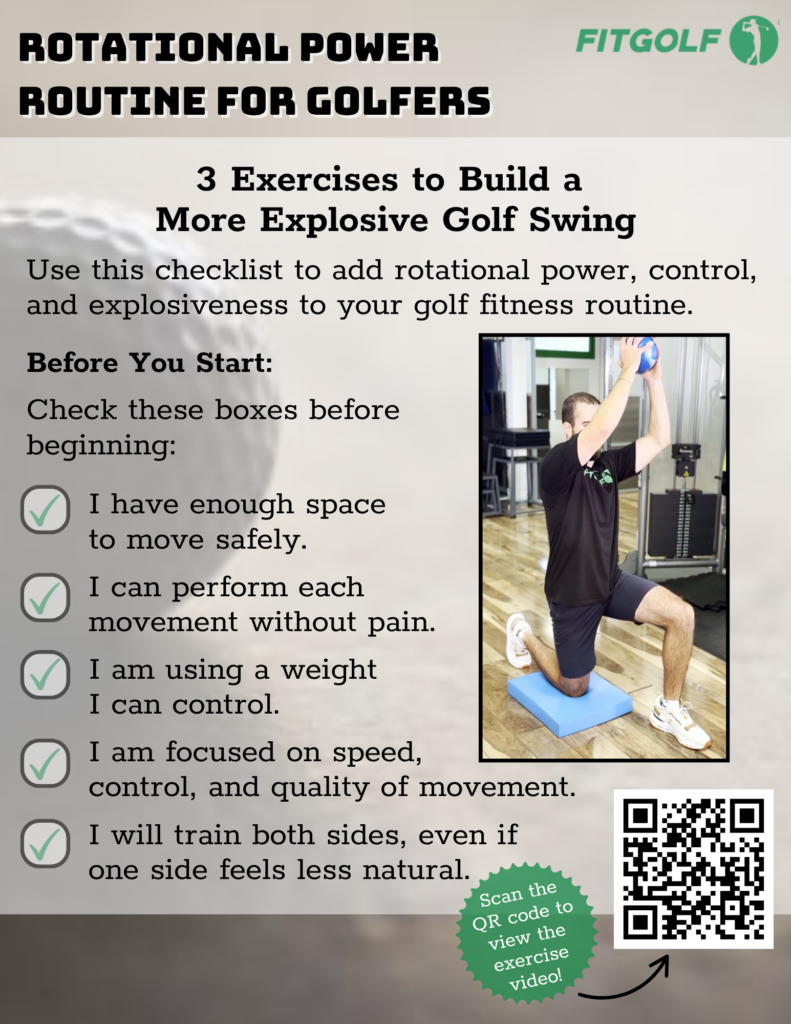
Don't try to mimic your golf swing.
One of the biggest mistakes golfers make is trying to make every exercise look exactly like their golf swing. That’s not the goal. The purpose of training is to improve the physical qualities that support your swing, not replicate it.
Effective golf fitness training develops:
- Hip rotation
- Core stability
- Rotational power
- Speed production
- Upper – and lower – body separation
- Force absorption and deceleration
As these qualities improve, golfers typically move better, feel more athletic, and generate speed more naturally.
Start training smarter.
Many golfers assume distance is purely a swing mechanics issue. At FitGolf, we see a different reality. Most golfers simply lack the physical capacity to create and control rotational power effiiciently. When you improve those physical limitations, distance becomes a natural byproduct of better movement, better sequencing, and better athleticism.
If you want to hit the ball farther, don’t just train harder. Train smarter.
Focus on developing the physical qualities your sport actually demands, you’ll unlock distance that may have been missing for years.
Ready to add distance?
If you’re curious whether physical limitations are holding back your swing speed and distance, schedule a complimentary golf fitness assessment with FitGolf Performance Centers.
We’ll identify the mobility, stability, strength, and power limitations that may be costing you yards and show you exactly what to do about them.
Looking for more resources?
Looking for more exercise resources, blog posts or monthly golf-specific exercise content sent straight to your inbox?
