
If you’ve lost distance over the past few years, your swing might not be the problem.
At FitGolf Performance Centers, one of the most common physical limitations we see in golfers is restricted hip rotation. Many golfers blame their mechanics, equipment, or age, but the reality is that your body often determines what your swing is capable of doing.
When the hips can’t rotate efficiently, compensations begin to appear. These compensations not only rob you of clubhead speed and distance, but they can also increase stress on your lower back and lead to inconsistent ball striking.
Why hip rotation matters
The golf swing works from the ground up.
Force starts at the feet and transfers through the hips, trunk, arms, and eventually into the clubhead. When hip mobility is restricted, that transfer of energy becomes less efficient.
Poor hip rotation commonly leads to:
- Loss of clubhead speed
- Reduced power transfer
- Difficulty clearing the pelvis
- Inconsistent contact
- Increased stress on the low back
- Overuse of the arms and hands
These limitations become especially common in golfers over 50 due to years of sitting, previous injuries, and natural decreases in mobility.
Three Common Swing Faults Caused by Poor Hip Rotation
1. Excessive Sway
Instead of rotating around a stable center, many golfers slide laterally during the backswing and downswing. This makes it harder to consistently square the clubface and reduces rotational power.
2. Overactive Arms and Wrist Flipping
When the lower body stops rotating, the arms take over. This often causes:
- Casting
- Early release
- Scooping
- Loss of compression
- Reduced clubhead speed
Rather than creating speed from the ground up, golfers are forced to manufacture it with their hands.
3. Early Extension
Early extension occurs when the pelvis moves toward the golf ball instead of rotating around the body. This commonly causes:
- Loss of posture
- Blocks and hooks
- Inconsistent contact
- Lower clubhead speed
- Increased low back stress
What Efficient Hip Rotation Looks Like
In an efficient golf swing:
- You load into the trail hip.
- The pelvis remains stable.
- The hips rotate through impact.
- The chest continues rotating toward the target.
- Energy transfers efficiently into the clubhead.
Better hip mobility allows the entire body to work together, improving speed, consistency, and longevity.
If you try these exercises and find them to be too challenging or uncomfortable, do not continue until you have consulted with your physician. All exercises for golf should be customized to your needs after a proper evaluation.
Download the free workout checklist!
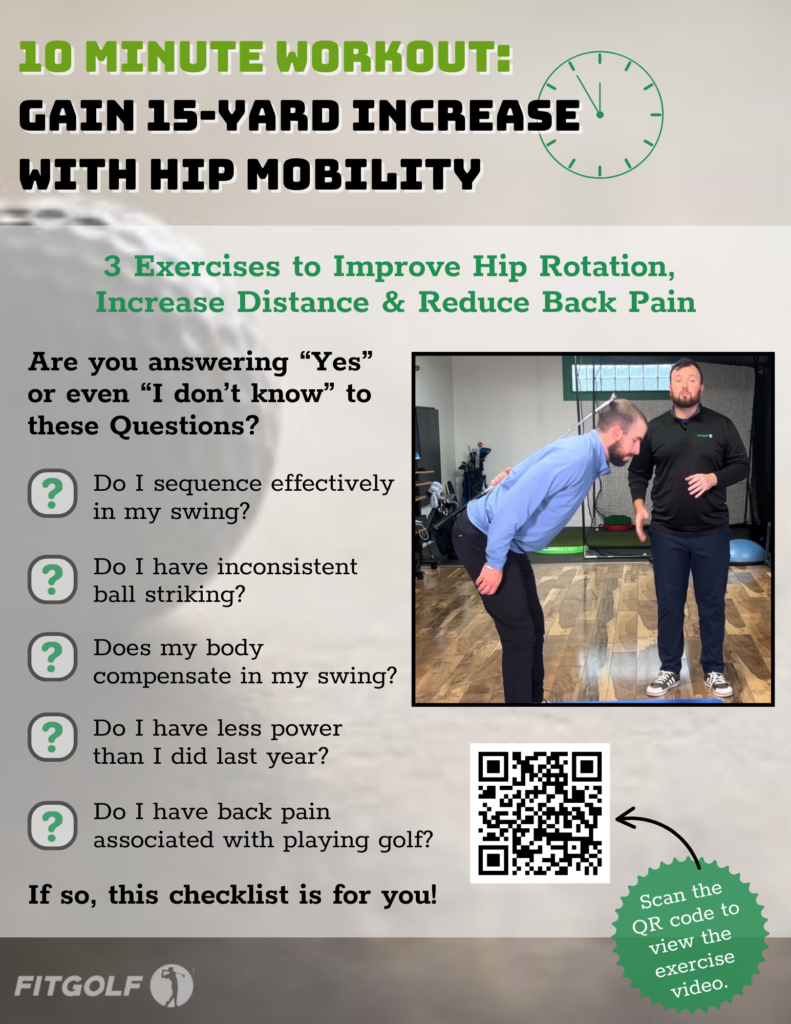
Three Exercises to Improve Hip Rotation
1. Half-Kneeling Hip Flexor Stretch
This stretch helps:
- Improve hip extension
- Reduce excessive pelvic tilt
- Improve rotational ability
2. 90-90 Hip Switch
One of the best drills for improving internal and external hip rotation. Benefits include:
- Better rotational control
- Increased mobility
- Improved movement awareness
3. Good Morning Hip Hinge
This drill teaches golfers to move from the hips rather than the low back. Benefits include:
- Better pelvic control
- Improved glute and hamstring function
- Reduced low back stress
Don't ignore the body-swing connection!
Many golfers spend years trying to fix swing mechanics without addressing the physical limitations causing those movement patterns.
If your hips cannot rotate efficiently, your body will always find another way to complete the swing – even if that means sacrificing speed, consistency, or your back health.
At FitGolf Performance Centers, we begin with a comprehensive evaluation to identify the physical limitations influencing your swing. Through mobility assessments, orthopedic testing, and golf-specific movement analysis, we help golfers improve:
- Hip mobility
- Rotational power
- Consistency
- Distance
- Longevity
Final Thoughts
If you’ve:
- Lost distance
- Feel tight during your swing
- Experience low back irritation after golf
- Struggle with consistency
- Feel like your body gets in the way of your swing
There’s a good chance your hips are contributing to the problem. Improving hip mobility and rotational control can help restore efficient movement patterns, improve power transfer, and help you play the game you love for years to come.
Come In and See Us
Want to take your golf to the next level? Our FitGolf® Trainers are experts at working one-on-one with you to tailor a training program to meet the specific needs of your body and help you achieve the results you are hoping to see in your golf.
Looking for more resources?
Looking for more exercise resources, blog posts or monthly golf-specific exercise content sent straight to your inbox?
