
At a certain point, almost all golfers deal with shoulder issues, whether it’s just a little tightness and stiffness or something more serious like a rotator cuff or labral injury. Shoulder pain and stiffness are among the most common problems we see, especially in golfers over 50.
Unfortunately, I find that most golfers with shoulder issues have had very little success resolving their issues – even those who have tried surgery, physical therapy, chiropractic, massage therapy, or countless stretches on YouTube.
Why Shoulder Mobility Matters in the Golf Swing
The golf swing requires a lot of shoulder mobility, especially:
- Should flexion (“getting the hands up”)
- Shoulder external rotation (trail arm “tray” position)
- Trunk rotation (shoulder/chest turn)
When golfers lose these movements, the swing starts finding workarounds or compensations. When the shoulders can’t move well, golfers often start to:
- Fly the trail elbow
- Come over the top
- Lose posture or stand up
- Lift the arms instead of turning
- Chicken wing through impact
- Early release or scoop the club
Many golfers think these are only swing technique issues. Sometimes they are; but many times, the body physically can’t get into the positions the golfer is trying to achieve. That’s why some golfers feel like they’re constantly fighting their swing, no matter how many lessons they take.
These compensations also affect performance. We commonly see:
- Loss of distance
- Poor contact
- Inconsistent ball striking
- Slices and pulls
- Timing-dependent swings
Usually, the golfer’s body is fighting the swing before the swing itself becomes the problem.
What I’ve Learned Working With Golfers With Shoulder Problems
One of the biggest things I’ve learned over the years is this: Most golfers try to stretch or strengthen the shoulder itself over and over again without first addressing posture.
That usually doesn’t work very well. Many golfers with shoulder limitations also have:
- Rounded shoulders
- Forward head posture
- Stiff upper backs
- Tight lats and chest muscles
If your upper back and posture are stiff, it’s like trying to swing with the parking brake on. The shoulder joint can only work as well as the posture supporting it.
One golfer I worked with this past winter was in his 60’s and had rotator cuff surgery about six months before coming to FitGolf. When he first came in, he only had about 50 degrees of shoulder external rotation and roughly 130 degrees of shoulder flexion. From a normal daily living standpoint, he had technically done “well”. He had already been discharged from physical therapy because he was relatively pain-free and functional.
But golf is different. An efficient golf swing requires significantly more mobility than everyday life, especially shoulder external rotation and overhead mobility. Without it, golfers almost always start compensating somewhere else in the swing.
That’s where many golfers get frustrated. They’re told they’re “fine”, but their body still can’t move well enough to swing efficiently. That’s the gap we try to fill at FitGolf.
After about 2-3 months of training focused on posture, thoracic mobility, shoulder mobility, and movement integration, we were eventually able to restore the mobility he needed to swing with far fewer compensations. This is why we usually focus first on improving:
- Upper back/thoracic spine mobility
- Posture
- Rib cage position
- Shoulder movement
Once posture improves, the shoulders almost always become easier to loosen up.
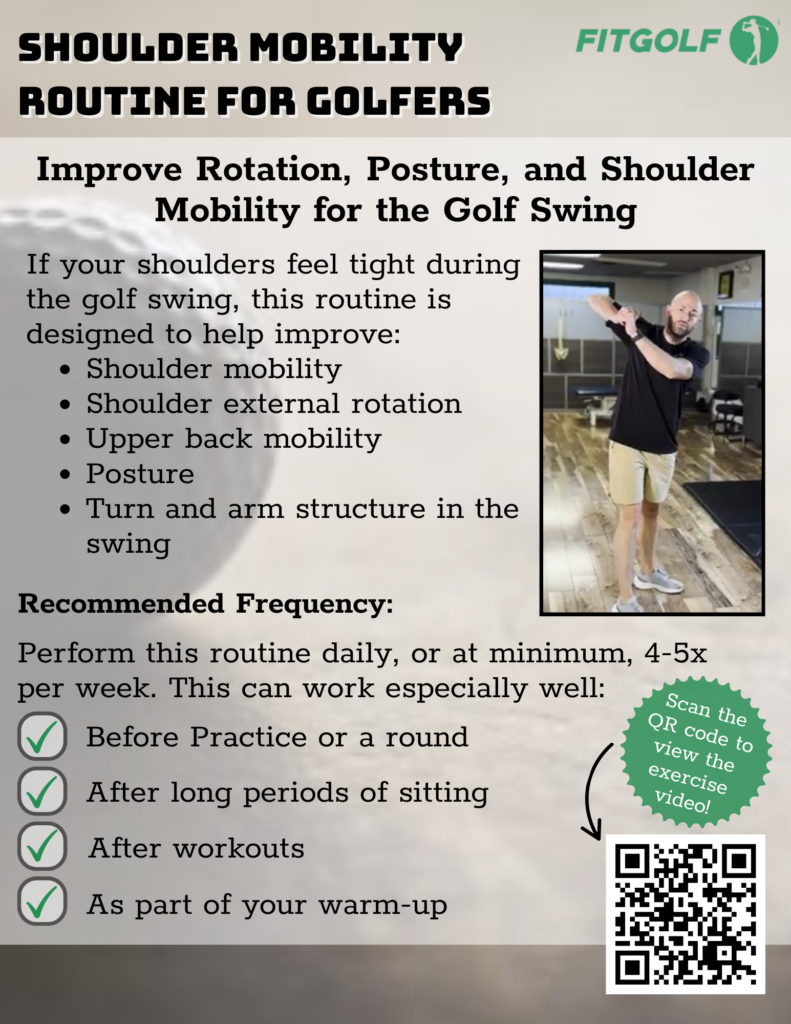
I’ve seen golfers struggle with shoulder mobility for years, then make noticeable improvements in just a few weeks once we addressed the upper back and posture correctly. What you’ll see in the following video is the set of exercises the FitGolf client went through at the beginning of his program.
If you try these exercises and find them to be too challenging or uncomfortable, do not continue until you have consulted with your physician. All exercises for golf should be customized to your needs after a proper evaluation.
Download the free workout checklist!
The Thought Process Behind the Exercises in This Video
The exercises in this video are designed to follow a simple progression. First, we loosen up the areas that commonly get stiff:
- Upper back
- Lats
- Back of the shoulders
Then we work on improving upper back extension and rotation. After that, we move into exercises that improve:
- Shoulder mobility
- Shoulder external rotation
- Posture
- Shoulder blade control
The goal isn’t just to stretch. The goal is to help golfers move better and control those positions better. That’s a big difference.
These Exercises Are Just the Starting Point
For many golfers, these exercises are a great first step, but long-term improvement usually requires more progression. Most golfers eventually need:
- Strength work
- Movement integration – or in other words, learning how to actually use newfound mobility and strength in the golf swing
- Rotary stability and core exercises
- Golf-specific movement drills
Otherwise, the body often falls back into the same old compensations. The golfers who improve the most are usually the ones who combine:
- Mobility
- Strength
- Posture
- Movement training
That’s when you start seeing:
- Better rotation
- Cleaner contact
- More distance
- Improved consistency
- Less pain during and after golf
If your shoulders have felt tight for years, don’t assume it’s just something you have to live with. In many cases, the problem is more fixable than golfers think – you just need the right approach.
-Jason Rivkin
FitGolf Performance Centers
Come In and See Us
Want to take your golf to the next level? Our FitGolf® Trainers are experts at working one-on-one with you to tailor a training program to meet the specific needs of your body and help you achieve the results you are hoping to see in your golf.
Looking for more resources?
Looking for more exercise resources, blog posts or monthly golf-specific exercise content sent straight to your inbox?
