
A Simple Drill and Exercise Progressions PGA Professionals Can Use to Improve Setup, Turn, and Movement Quality
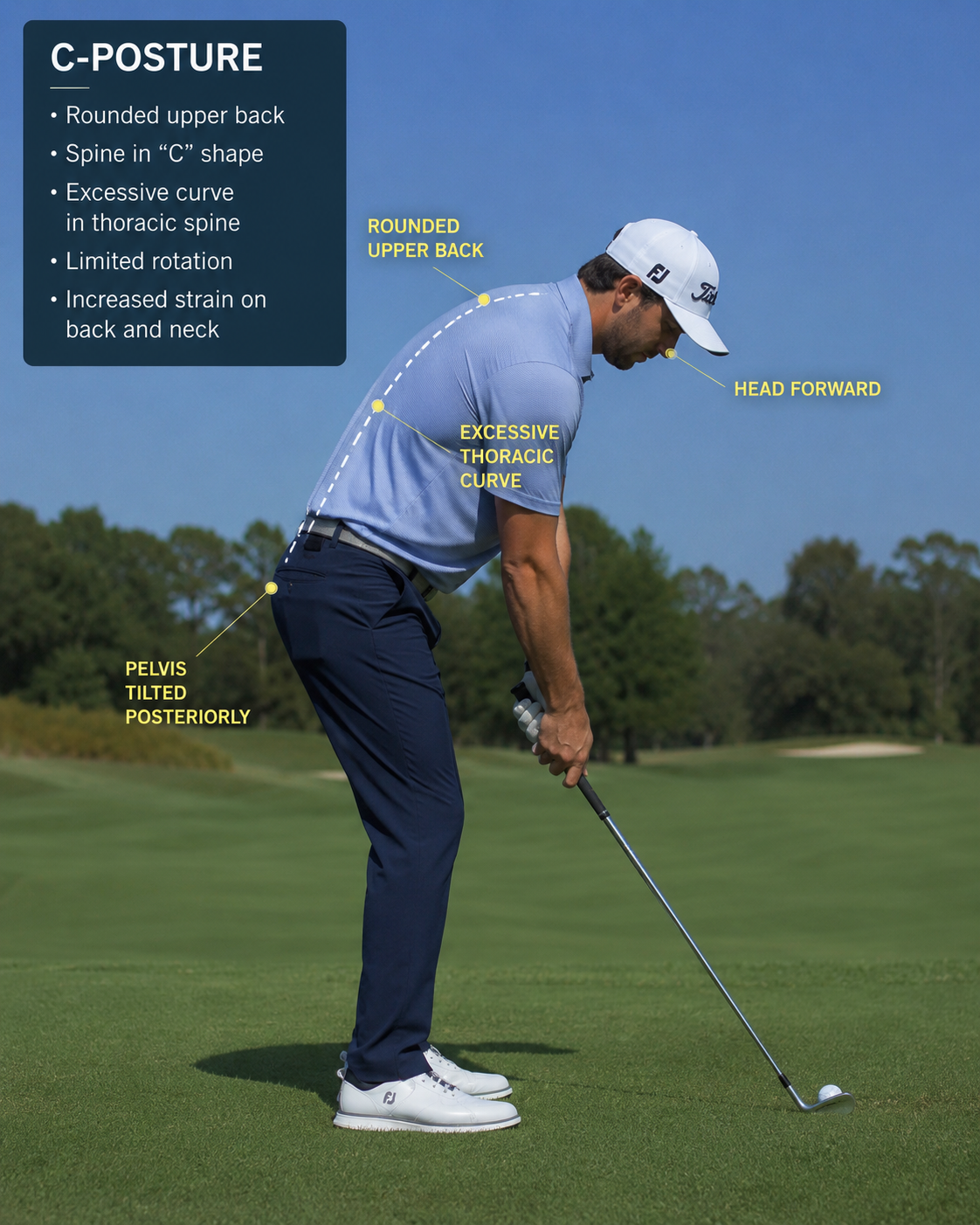
One of the most common movement issues we see at FitGolf is excessive thoracic flexion, more commonly known as C-posture. These golfers typically present with:
A rounded upper back at address
Forward shoulders
Limited ability to hip hinge
Poor thoracic extension and rotation
From a swing standpoint, these players often struggle to:
Create depth in the backswing
Maintain posture
Rotate efficiently
Sequence the body properly
While C-posture is commonly discussed as a setup issue, it is frequently a movement and mobility issue first.
Why Thoracic Flexion Limits Rotation
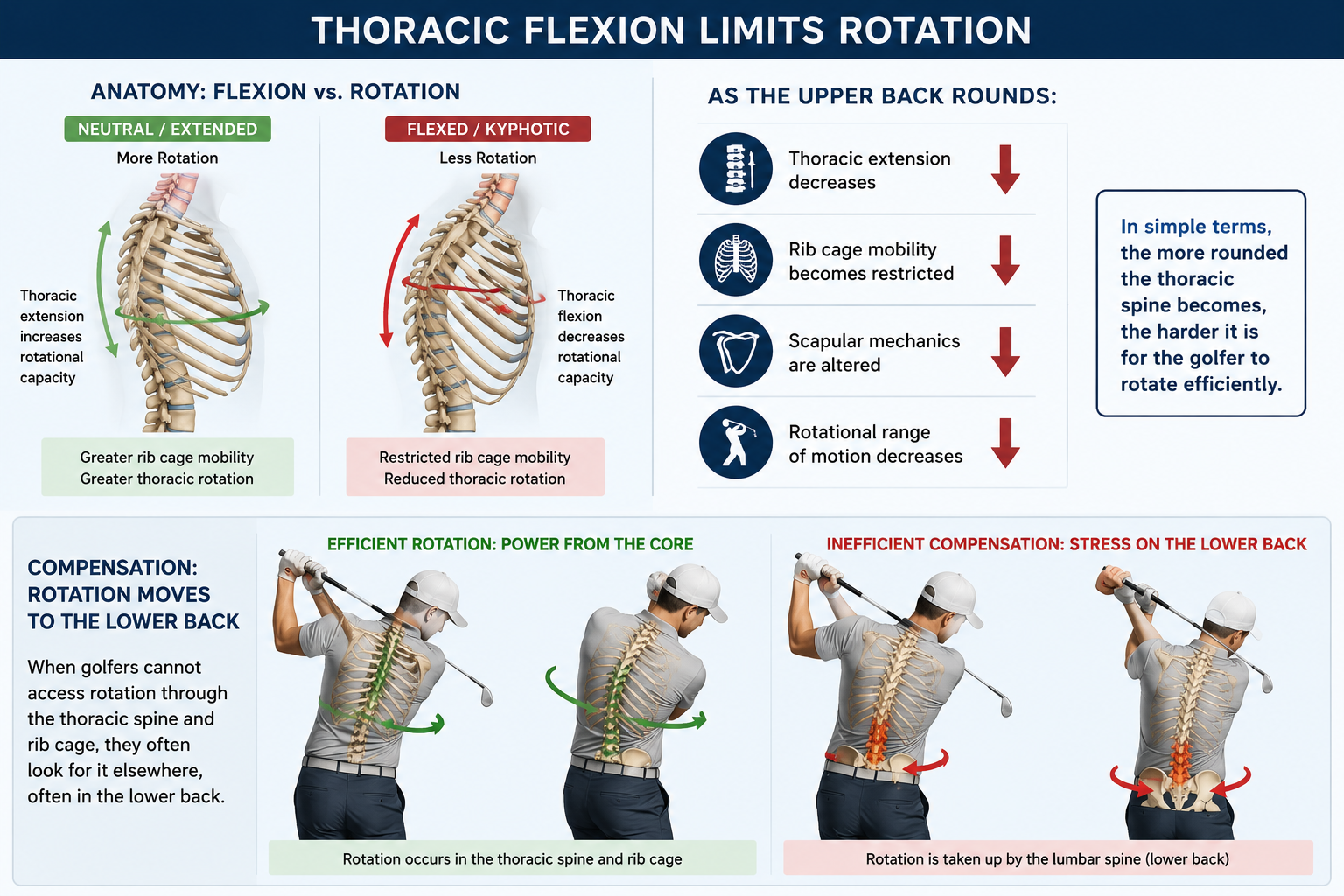
The thoracic spine plays a significant role in rotational movement during the golf swing. However, when the thoracic spine is excessively flexed or kyphotic, rotation becomes biomechanically much more difficult.
As the upper back rounds:
Thoracic extension decreases
Rib cage mobility becomes restricted
Scapular mechanics are altered
The rotational range of motion decreases
In simple terms, the more rounded the thoracic spine becomes, the harder it is for the golfer to rotate efficiently.
When golfers cannot access rotation through the thoracic spine and rib cage, they often look for it elsewhere, often in the lower back.
What Causes Excessive Kyphosis and C-Posture?
For many golfers, excessive thoracic flexion is not simply a “bad habit.” It is often the result of muscular tightness, weakness, restricted mobility, and poor motor control patterns developed over the years.
Common Tight Structures:
Golfers with C-posture frequently demonstrate tightness in:
Pecs/Chest Muscles
Lats
Hamstrings
Hip flexors
These restrictions tend to pull the body into a more flexed posture while limiting thoracic extension and overhead mobility.
Common Weak or Underactive Muscles:
At the same time, these golfers often lack strength or endurance in:
The upper back
The glutes
Core muscles responsible for postural control
When these muscles cannot effectively stabilize the spine and rib cage, maintaining posture throughout the golf swing becomes significantly more difficult.
Why We Address Posture Before Rotation
One of the biggest mistakes we see is aggressively chasing rotation before first improving posture and thoracic positioning.
At FitGolf, we typically begin by improving:
Thoracic extension
Rib cage positioning
Scapular (shoulder blade) control and stability
Hip hinge mechanics
Postural awareness and endurance
…before progressing into more aggressive rotational mobility and power work.
Why this matters...
If a golfer attempts to rotate from a flexed, kyphotic position:
Rotation is limited from the start
Compensations become reinforced
Stress often shifts into the lumbar spine, shoulders, elbows, or wrists
By first improving posture and the golfer’s ability to correctly organize the thoracic spine and pelvis, rotational drills become significantly more effective and safer to perform.
Simply put: Better posture creates a better environment for rotation.
A Simple Drill to Improve Posture and Hip Hinge Mechanics
One of our favorite drills at FitGolf to improve posture and setup mechanics is the Hip Bar Hinge Drill. This drill helps golfers feel:
A neutral spine
Better hip hinge mechanics
Improved space for the arms
Proper pelvic positioning at address
The key is teaching the golfer to hinge by moving the hips back—not by excessively flexing through the spine.
Often, just a few repetitions can dramatically improve posture and setup awareness.
A Simple Exercise Routine to Improve Posture
While setup drills can create immediate changes, long-term improvement typically requires addressing the underlying mobility restrictions and muscular imbalances contributing to C-posture in the first place.
At FitGolf, we commonly combine:
Soft tissue and mobility work
Thoracic extension exercises
Scapular stabilization work
Core control exercises
Hip hinge retraining
Below is a simple progression PGA Professionals can use with students struggling with posture and rotation.
1. Pec Stretch
Goal: Improve thoracic spine and shoulder mobility
Golfers with excessive kyphosis are often tight through the pectoralis major and minor, which can pull the shoulders forward and contribute to rounded posture.
Coaching Focus:
Keep rib cage down
Avoid arching your lower back
Breathe deeply during the stretch
Recommended:
1 set of 1-2 minutes
2. Prayer Stretch for the Lats
Goal: Improve thoracic spine and shoulder mobility
Tight latissimus dorsi muscles can limit shoulder flexion and contribute to excessive spinal flexion during setup and rotation.
Coaching Focus:
Sit hips back
Keep chest “long.”
Exhale fully during the stretch
Recommended:
2 sets of 5–6 deep breaths per side
3. Two-Arm Cable Row
Goal: Improve scapular retraction and postural strength
Golfers with excessive C-posture often struggle to maintain proper scapular positioning and thoracic extension throughout the swing. The 2-arm cable row helps strengthen the posterior musculature responsible for maintaining posture and supporting efficient rotation.
This exercise primarily targets:
Rhomboids
Middle and lower trapezius
Posterior shoulder musculature
Thoracic extensors
By improving scapular control and postural endurance, golfers are often better able to maintain posture during both setup and rotation.
Coaching Focus:
Keep chest “tall” throughout the movement
Pull shoulder blades back without shrugging
Avoid excessive lower back arching
Maintain rib cage control and neutral spine
Recommended:
2–3 sets of 8–12 repetitions
4. Kettlebell Deadlift
Goal: Reinforce hip hinge mechanics, glute/core strength, and postural control
Once golfers begin improving thoracic mobility and postural awareness, they need to learn how to maintain those positions under load and movement. The kettlebell deadlift is an excellent exercise for reinforcing proper hip hinge mechanics while strengthening the muscles responsible for posture and stability.
This exercise helps golfers develop:
Glute and hamstring strength
Hip hinge mechanics
Core stability
Postural endurance
Better control of spinal positioning during movement
For golfers with C-posture, the kettlebell deadlift teaches them to bend from the hips while maintaining a more neutral spine and a more organized rib cage.
Coaching Focus:
Slight knee bend
Push hips back during descent
Maintain a “long chest” and neutral spine
Keep weight balanced through midfoot/heels
Stand tall using the glutes, not the lower back
Recommended:
2–3 sets of 6–10 repetitions
Final Takeaway
The goal is not to create “perfect posture.”
The goal is to place the golfer in a position where efficient rotation is easier, and compensations are less necessary.
For many golfers—especially older players—improving posture and hip-hinge mechanics is one of the fastest ways to enhance movement quality, rotational capacity, and consistency on the golf course.
Jason Rivkin, TPI Certified
Explore More Resources
Come In and See Us
Want to take your golf to the next level? Our FitGolf® Trainers are experts at working one-on-one with you to tailor a training program to meet the specific needs of your body and help you achieve the results you are hoping to see in your golf.
Have a question? Ask a FitGolf trainer.
Fill out the form below to connect with one of our golf fitness professionals:

