
If you’re a golfer over 50, you may have noticed a decrease in distance, speed, or overall strength in your swing. Maintaining the physical qualities that support a powerful and consistent golf swing becomes more challenging as we age.
This isn’t just anecdotal. Research consistently shows that adults lose approximately 1–1.5% of muscle strength per year after the age of 50 if strength training is not performed regularly. This gradual decline is part of a condition known as sarcopenia, the age-related loss of muscle mass, strength, and physical performance.
Over time, these small yearly losses compound. Between the ages of 50 and 70, individuals can lose up to 30% of their muscle strength if preventative measures aren’t taken.
For golfers, this can translate to:
• Reduced clubhead speed
• Loss of distance
• Decreased stability and balance
• Greater risk of injury
More importantly, declining strength can affect everyday activities such as climbing stairs, carrying groceries, playing with grandchildren, or simply getting up from a chair.
Golfers Are Aging — and Playing More Than Ever
Golf remains one of the few sports people can play for their entire lives. In fact, the sport is dominated by older participants.
According to research from the National Golf Foundation, approximately 43% of on-course golfers in the United States are age 50 or older, with roughly 20% over the age of 65.
At the same time, overall golf participation continues to grow. Today, more than 47 million Americans engage with golf annually, either through traditional on-course play or off-course experiences like driving ranges and simulators.
This means a large portion of golfers are navigating the physical changes that come with aging while still trying to maintain performance on the course.
Why Strength Training Is Essential for Golfers Over 50
The good news is that these age-related changes are highly modifiable.
Research consistently shows that strength training is the most effective intervention for slowing or reversing the effects of sarcopenia.
For golfers, maintaining strength directly supports the physical demands of the golf swing. Stronger muscles allow golfers to generate more force against the ground, stabilize the spine and pelvis during rotation, and maintain control throughout the swing.
Strength training can help golfers:
• Maintain or increase clubhead speed
• Improve power production
• Enhance balance and stability
• Reduce injury risk
• Maintain independence and quality of life
There is also strong evidence linking grip strength and overall muscular strength to longevity and overall health outcomes in older adults, further highlighting the importance of maintaining strength as we age.
The Reality: Most Golfers Don’t Strength Train
Despite the clear benefits, most golfers who walk through our doors for the first time have never performed a structured strength training program.
If that sounds familiar, you’re not alone.
Many golfers assume they need to stretch more or simply play more golf to improve their performance. While mobility and practice are important, strength is the foundation that allows golfers to maintain speed, stability, and durability.
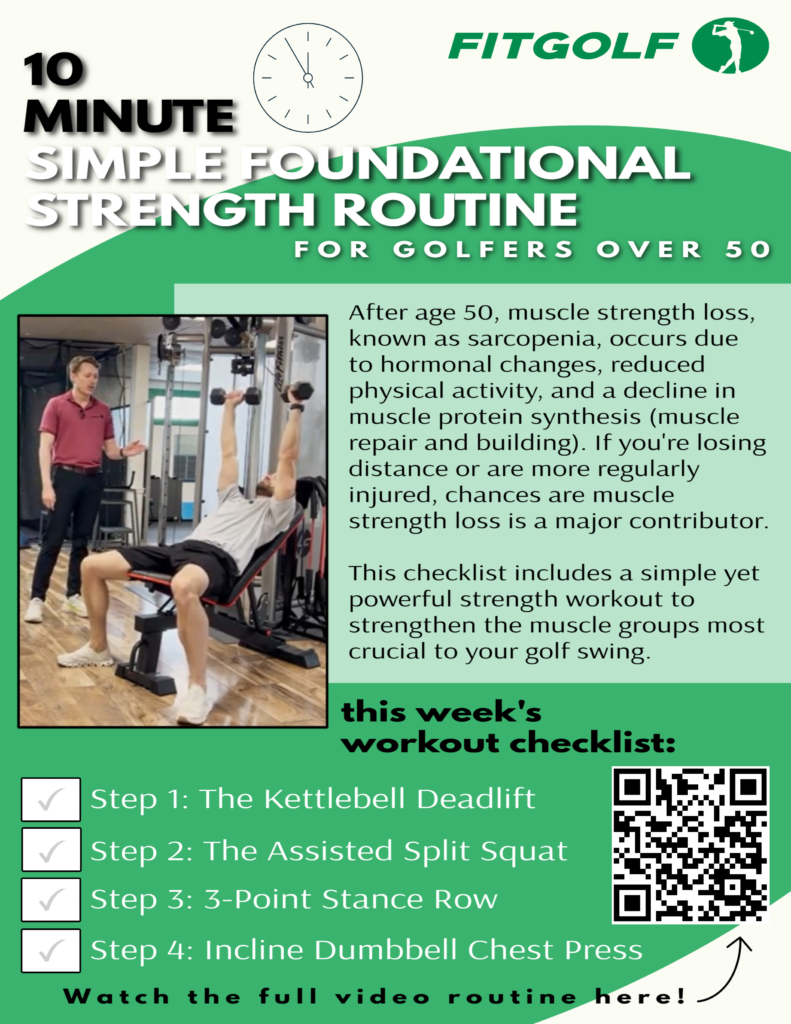
If you’re new to strength training or returning after time away, the four exercises in the video below are an excellent place to start.
They target the lower body, core, and upper body, the key areas responsible for generating power and maintaining control during the golf swing.
Essential Strength Exercises for Golfers Over 50
1. Lower Body Strength
The golf swing begins from the ground up. Lower-body strength allows golfers to push against the ground and create the force needed for speed and power.
Strengthening the glutes, quadriceps, and hamstrings improves:
• Ground force production
• Balance during the swing
• Stability during weight transfer
Exercises such as deadlifts, squats, and step-ups are excellent for building this foundation.
2. Upper Body Strength
The upper body plays a major role in transferring force through the club.
Strong shoulders, chest, and back muscles help golfers maintain posture and control throughout the swing while protecting the shoulders and spine from injury.
Upper-body exercises can improve:
• Postural strength
• Arm speed and force transfer
• Shoulder durability
Examples include rows, push-ups, and presses.
3. Rotational Power
Golf is fundamentally a rotational sport. The ability to produce rotational speed is essential for generating clubhead speed and distance.
Rotational power exercises train the body to create force quickly and efficiently.
These movements can improve:
• Swing speed
• Sequencing and coordination
• Energy transfer through the body
Exercises like medicine ball rotational throws and dynamic rotational movements help build this capacity.
4. Core Stability
The core serves as the bridge between the lower and upper body during the golf swing.
A strong and stable core helps golfers maintain posture and control while rotating at high speeds.
Improving core stability can help:
• Protect the spine
• Improve swing consistency
• Maintain balance throughout the swing
Exercises like planks, anti-rotation presses, and stability drills help develop this control.
How Often Should Golfers Train?
For best results, perform this workout 2–4 times per week.
Consistency is far more important than intensity, especially for golfers who are just beginning a strength training routine.
Over time, regular strength training can help you:
• Maintain muscle mass
• Preserve swing speed
• Improve balance and control
• Reduce injury risk
Most importantly, it helps ensure that you can continue playing golf at a high level and enjoy the game for decades to come.
If you try these exercises and find them to be too challenging or uncomfortable, do not continue until you have consulted with your physician. All exercises for golf should be customized to your needs after a proper evaluation.
Download the free workout checklist!
Explore More Resources
Come In and See Us
Want to take your golf to the next level? Our FitGolf® Trainers are experts at working one-on-one with you to tailor a training program to meet the specific needs of your body and help you achieve the results you are hoping to see in your golf.
Have a question? Ask a FitGolf trainer.
Fill out the form below to connect with one of our golf fitness professionals:
